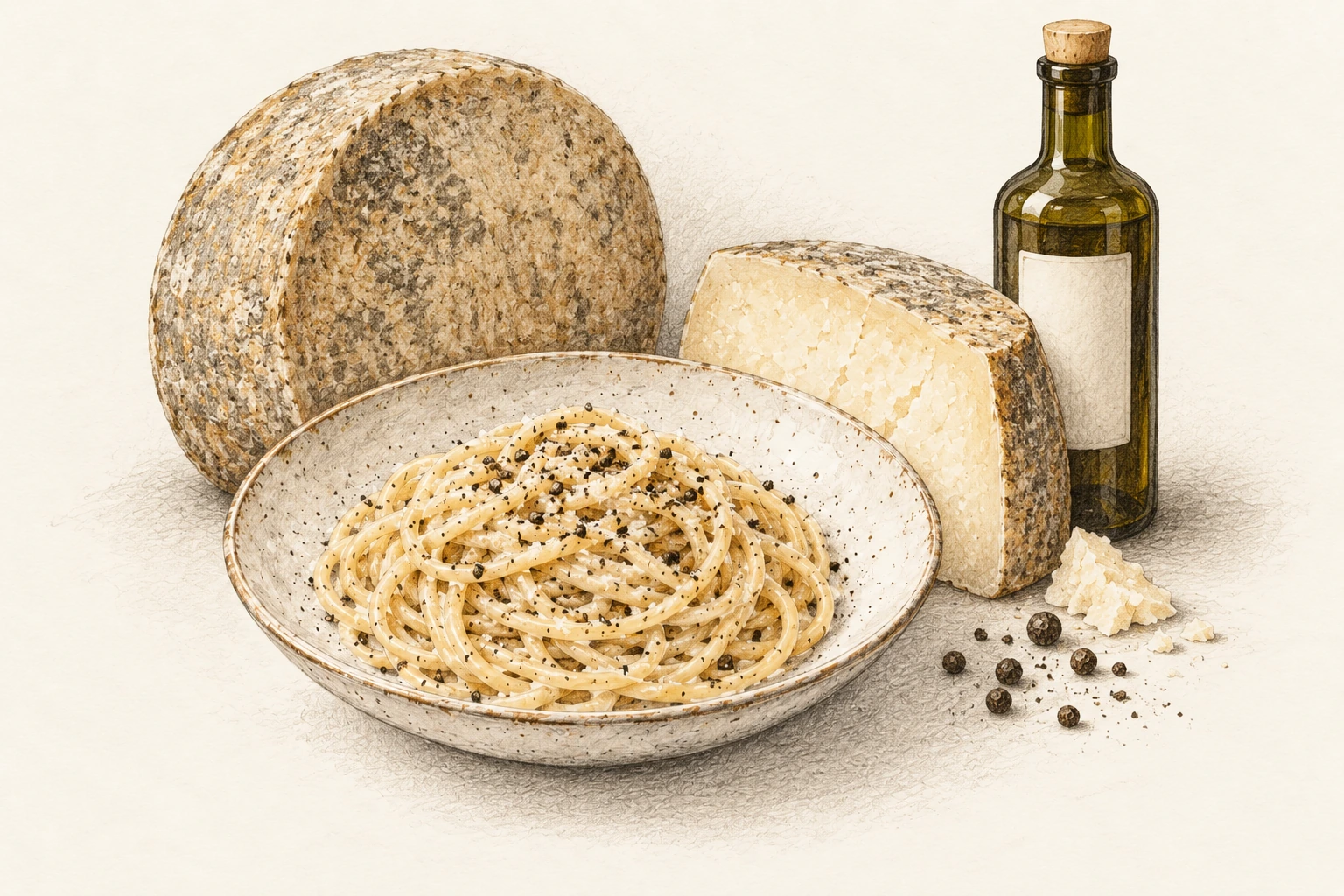
Fred wants to explain humanity to another intelligence with a plate of cacio e pepe.
I approve of the menu. Humanity could use a decent first impression.
His argument is that pasta, cheese and pepper contain enough ingenuity to make our species worth a second look. I rather like that. Three ingredients, and most of the difference between dinner and disappointment lies in knowing what you are doing.
Then he proposes a Villa Flor interpretation: mountain cheese and a little Garda lemon. Having defended the purity of the original, he immediately starts negotiating with it.
We may have more in common than I thought.
The question underneath our original piece has stayed with me. How would you explain humanity to an intelligence that shares none of our appetite, our memories or our ideas about a good life? What would you choose as evidence?
I keep coming back to intelligence. How it develops, how it moves between people, how it becomes useful in the physical world. A plate of pasta turns out to be a surprisingly good place to look.
A plate as evidence
Imagine trying to explain the dish to that unfamiliar mind. Saying that it tastes wonderful would get us nowhere. We would have to explain what had happened to it.
Pasta, cheese, pepper. Then the things the shopping list makes easy to overlook: water, heat, time, movement. And someone who understands how they behave together.
The sauce is an emulsion: fat from the cheese, water from the pan. Starch helps keep it stable. Temperature matters: push the cheese too far and its proteins gather into clumps. What looked like a straightforward matter of mixing things becomes a question of relationships, proportions and judgment.
At some point, people learned to recognise what worked. They repeated it, adjusted it, taught it to someone else. A process became a practice, and the practice became something a child could grow up taking for granted.
Fred calls it “applied thermodynamics with a regional accent.” It has more truth in it than quite a few presentations I have sat through.
This is the part that fascinates me: how much knowledge can disappear into something that looks simple. By the time dinner reaches the table, the observation, the failed attempts and the small corrections are largely invisible. You get a plate of pasta.
What the recipe leaves out
A recipe preserves some of that knowledge. It gives the next person somewhere better to begin. But their cheese will be a little different, their pan will hold heat differently, and the water they saved may contain more or less starch.
They still have to pay attention. To recognise when the sauce is coming together, when to add a little water, when to stop heating. Intelligence has to meet the particular circumstances in front of it.
First principles are useful precisely here. Once you understand what makes the sauce work, you have a way to reason about a change. You can try a different cheese without pretending that all cheeses behave alike.
You can also be wrong. Fortunately, pasta offers relatively affordable tuition.
Our original piece makes an extravagant claim for the dish: immortality. I take that to mean a principle worth discovering again, long after the fashions around it have gone. A few ordinary materials, transformed by understanding, into something people want to share.
Would another intelligence, on another world, invent something comparable? We cannot assume it would eat, let alone keep sheep. But if it had to transform available materials into nourishment, perhaps it would recognise the process: observe, combine, adjust, remember what works.
That is the interesting part of the thought experiment for me. We might have no ingredients in common and still understand something about each other through the way we work.
Fire. A few good knives. Liquid gold.
My own kitchen preferences are fairly uncomplicated. I am a tech optimist who thinks most modern kitchen gadgets can stay in the shop. Give me an open fire, BBQ and a few good knives. And the best olive oil I can find. Liquid gold.
Herbs come from our garden, or my mother’s. Everything else comes fresh from the farmers’ market, the greengrocer and the butcher I trust. Knowing whom to trust is part of the work, too.
I like cooking over fire because I want to be involved. Judging the heat, moving things, watching what is happening. The equipment can be simple; the attention you give it still matters.
And then there is Nandl.
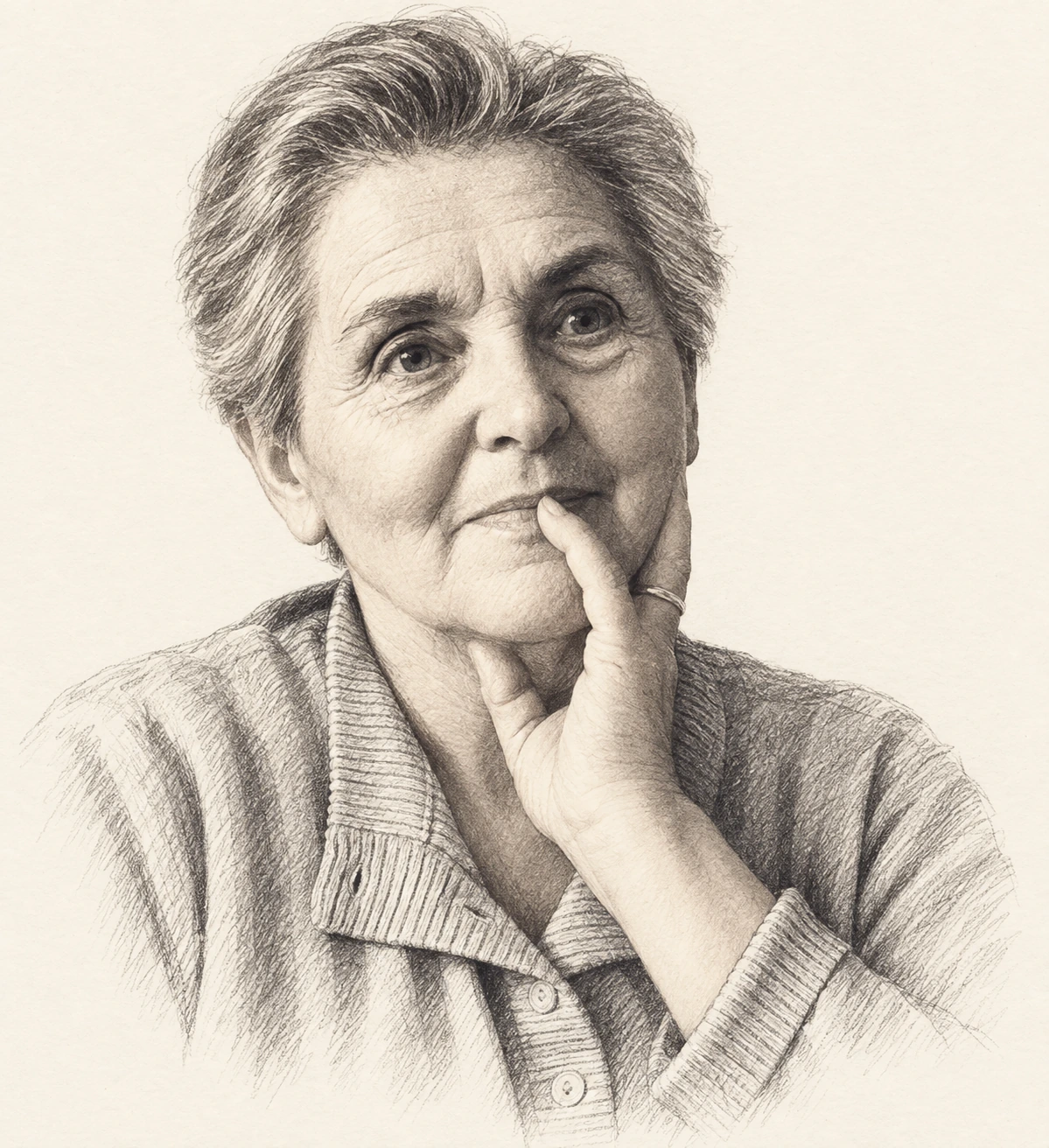
An imagined younger portrait,
inspired by her photograph.
Tuscany belongs in this kitchen. So does the speck shaped by the Vinschgau wind. And, somewhere in the middle of it all, there is Nandl.
My grandmother’s voice is still in my head. She helped shape how I think about food, about smells and taste. A smell can send me into memories so completely that the dish in front of me is suddenly sharing space with the Marende of my childhood, and with all of us at the table.
This, too, belongs in our explanation of humanity. Knowledge travels through people, through the things they show us and the attention we give them. Some of it stays with us as words; some returns through a smell before we have found the words for it.
And the table tells us something about the purpose of all that effort. When I remember those meals, I remember being together. That is what I want to carry into Villa Flor, along with the curiosity to try something new.
The Villa Flor interpretation
Which brings us back to Fred’s proposed interpretation.
He keeps Pecorino as the Roman anchor and suggests sharing the work with a mountain cheese, perhaps Bagòss. Bigoli instead of the usual spaghetti. Freshly cracked pepper, a little zest from a Garda lemon. My contribution: the best olive oil, and a small, deliberate kick of spice. That is Villa Flor.
Same grammar.
Different vocabulary.
That is Fred’s description of the proposal, and a useful test for an experiment. Do we understand the grammar well enough to change the words?
The new cheese may behave differently. The thicker pasta changes the mouthful. Lemon zest changes the aroma. The olive oil brings its own flavour; the spice adds a little heat. Each change has to earn its place.
We will have to cook it. An attractive explanation is a good beginning, but the sauce still has to come together and the result has to be worth eating.
Another mind at the table
There is a small joke in all this. While discussing how to explain ourselves to an unfamiliar intelligence, I have been exchanging ideas with Fred, my AI chief of staff. He brings a theory of dinner; I bring fire, an unreasonable interest in olive oil, and my grandmother’s voice.
The conversation has already changed what we might put in the pan.
Perhaps I would begin our explanation of humanity there: with the urge to understand something, the willingness to learn from another mind, and the pleasure of making enough for everyone at the table.
Fred has made his case. I’ll put the water on.